

With less than 40 days to go before the opening ceremony of the 2026 World Cup in the United States, Canada, and Mexico, the broadcasting rights for the tournament in China have yet to be secured. Reports indicate that negotiations between FIFA and China Central Television (CCTV) have hit a standstill. FIFA’s initial asking price for the single-tournament rights was a staggering $250 million to $300 million (approximately 18 to 21 billion RMB). After multiple rounds of discussions, the price has been reduced to $120 million to $150 million, but CCTV’s budget remains firm at $60 million to $80 million.
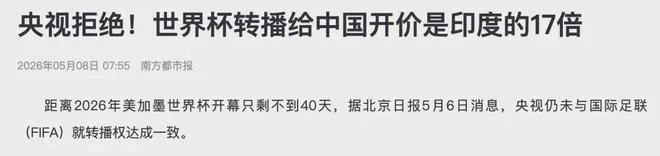
The exorbitant fee has sparked widespread media coverage. According to Chinese regulations, CCTV is the sole negotiator for major international sports events broadcast in the country, leaving no room for third-party platforms to drive up the price. However, FIFA appears eager to secure a deal, fearing the loss of the lucrative Chinese market. Reports suggest that a high-level FIFA delegation has recently visited China to expedite negotiations.
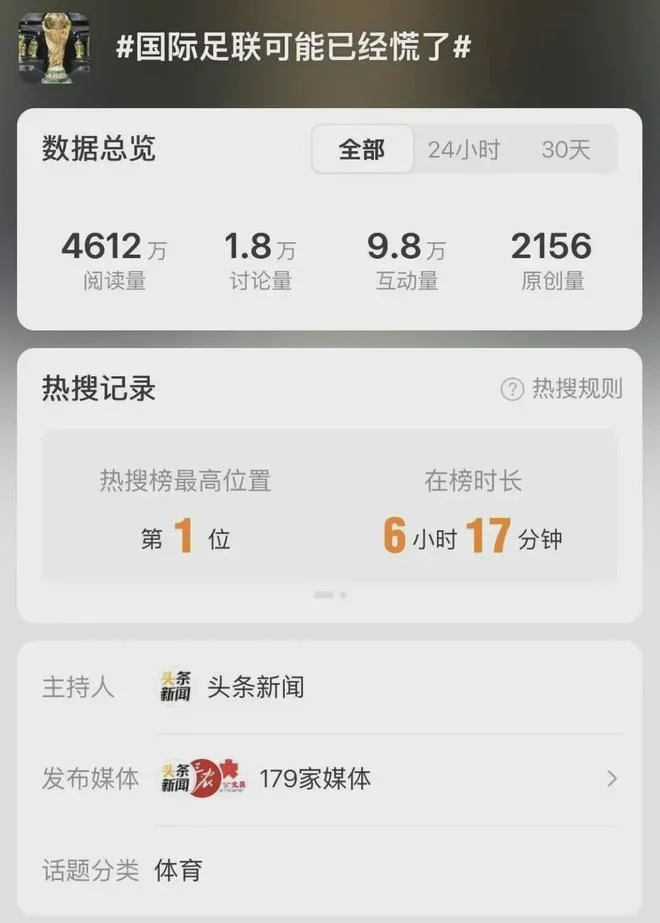
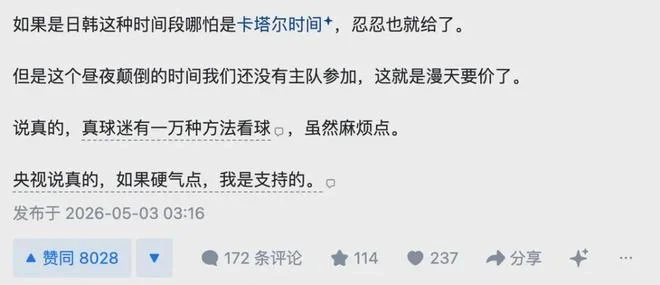
The topic has even trended on social media platforms. Many Chinese netizens have voiced support for CCTV’s refusal to pay what they consider an unreasonable fee. Some argue that FIFA should compensate CCTV for the late-night broadcast hours, as the time zone difference means that about 70% of the matches will air in the early hours of the morning in China.
Historically, the cost of World Cup broadcasting rights in China has skyrocketed. The 2002 and 2006 tournaments were bundled for $24 million, while the 2010 and 2014 events cost $115 million. The most recent package for 2018 and 2022 totaled approximately $300 million. FIFA’s pricing strategy categorizes China as a top-tier market, comparable to Europe and the United States, based on its large population and fan base. However, this pricing is far higher than what other Asian countries pay. For comparison, the UK paid $350 million for two tournaments, Japan $200 million, South Korea $125 million, and India was quoted $35 million for two tournaments.
CCTV’s stance is bolstered by the fact that the Chinese men’s national team has failed to qualify for the World Cup for six consecutive tournaments. This absence has reduced the urgency for Chinese broadcasters to secure the rights at any cost. In 2024, CCTV previously refused to broadcast the Asian Football Confederation’s World Cup qualifiers due to high fees, a move that was widely praised.
FIFA’s business model has also drawn criticism. The organization, often described as a commercial empire rather than a sports association, relies heavily on broadcasting rights for revenue. In 2025, broadcasting accounted for nearly 40% of FIFA’s income. The 2026 World Cup is projected to generate $130 billion in total revenue, with broadcasting fees alone exceeding $3.4 billion. However, FIFA has a history of corruption scandals, including bribery and ticket resale schemes involving high-ranking officials. The 2015 scandal, which led to the suspension of President Sepp Blatter, exposed systemic issues. More recently, the awarding of the 2022 World Cup to Qatar raised questions about integrity.
Despite these issues, Chinese fans have a deep emotional connection to the World Cup. The 2002 tournament, when the Chinese men’s team first and only qualified, saw record-breaking viewership. CCTV reported that over 700 million people watched the match against Brazil, and the team’s three group stage games attracted a total of 2 billion viewership. Since then, the team’s failure to qualify has dampened enthusiasm, but the desire to see the national team return remains strong.
The current standoff over broadcasting rights has become a focal point for Chinese fans, who see it as a fight against unfair pricing. Many netizens have joked that FIFA should first help China qualify for the World Cup before demanding such high fees. In a way, the team’s absence has given CCTV the leverage to resist the inflated price, turning a disappointing reality into a bargaining chip.
